
Short answer: a two-tone deck uses one color for the main field of boards and a contrasting color for the border, the stairs or a line through the middle. It’s one of the simplest ways to make a deck look custom, and with composite and PVC boards it doesn’t add any upkeep.
Most of the decks we build in Utah County and Salt Lake County now have at least one contrasting detail. Here’s how the different options work, where each one makes sense, and a few color pairings from decks we’ve built.
Picture-frame borders
A picture frame is a row of boards (sometimes two) that runs around the outside edge of the deck. It covers the cut ends of the field boards, so you never see the grooved edge of a board, and it gives the deck a finished, framed look like the trim on a room.
You can do a picture frame in the same color as the rest of the deck and it still looks sharp. Run it in a contrasting color and it becomes the main design feature.
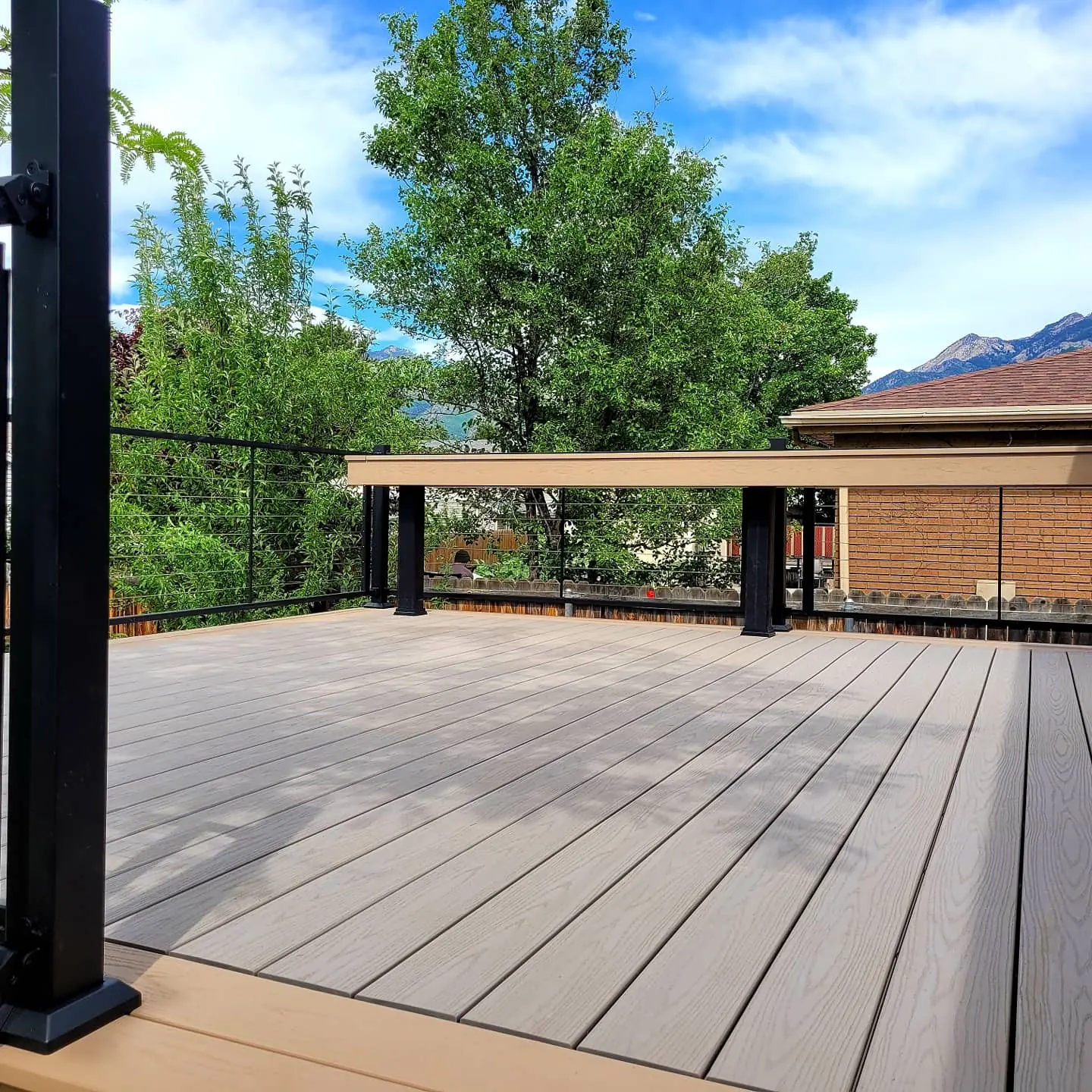
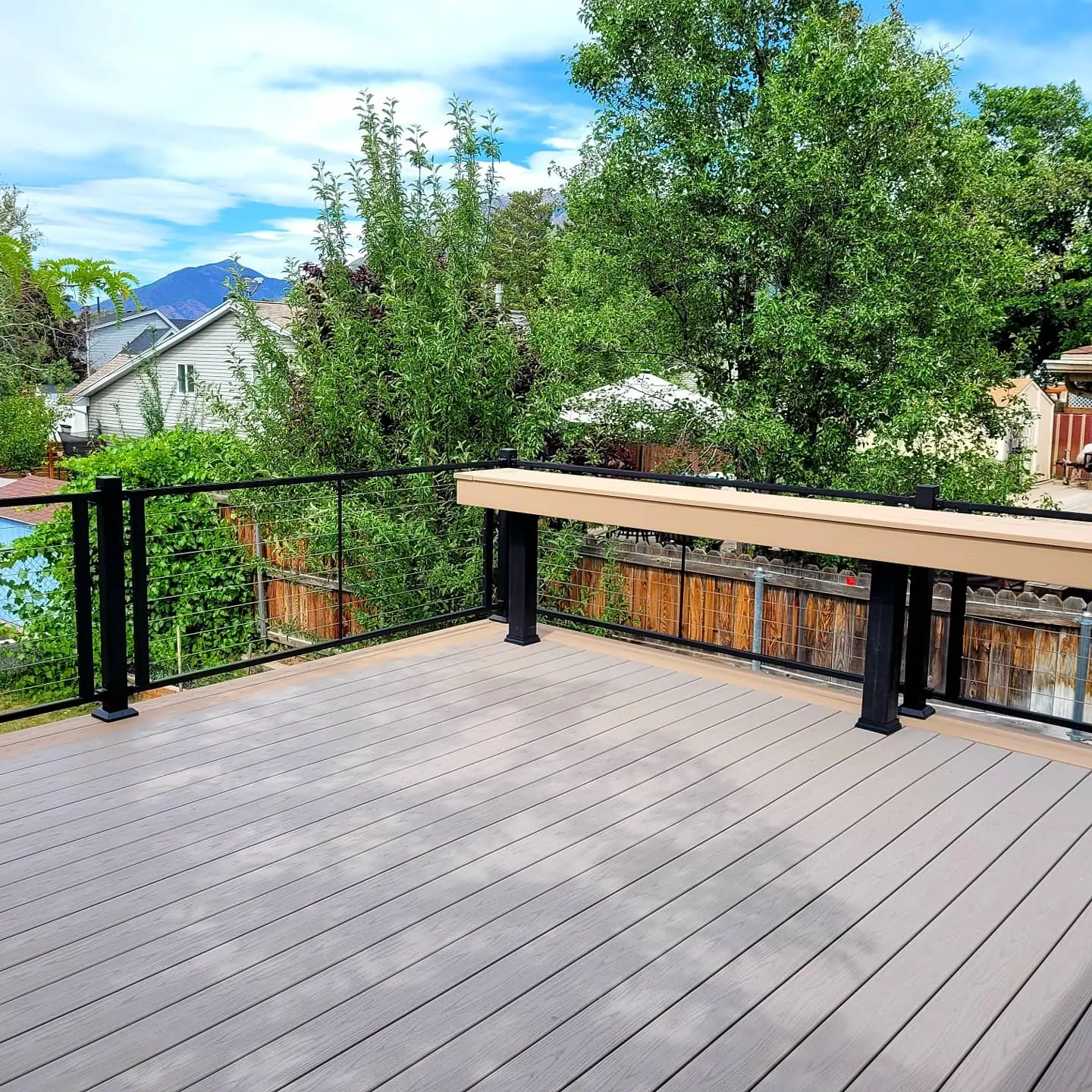
On a Draper deck we built, the field is TimberTech Slate Gray and the border, stairs and fascia are Brownstone. The warm brown frame ties into the home’s trim, and the black cable railing on top keeps the mountain view open. We even built a Brownstone bench right into the rail line so the accent color carries through.
Breaker boards
A breaker board is a board that runs perpendicular to the decking, splitting a long deck into sections. Composite boards come in set lengths, so on a big deck the boards have to end somewhere. A breaker board gives them a clean place to stop, instead of a row of butt joints scattered across the surface.
Breaker boards look best when they line up with something: the center of a slider, the edge of a covered area, or the line between a dining zone and a lounge zone. Done in a contrasting color, they turn a practical detail into a design line.
Stair nosing and risers
If you only add one accent, put it on the stairs. A contrasting board on the front edge of each tread (the nosing) makes every step easy to see, which is a real safety plus at dusk. White or dark risers behind it add even more definition.
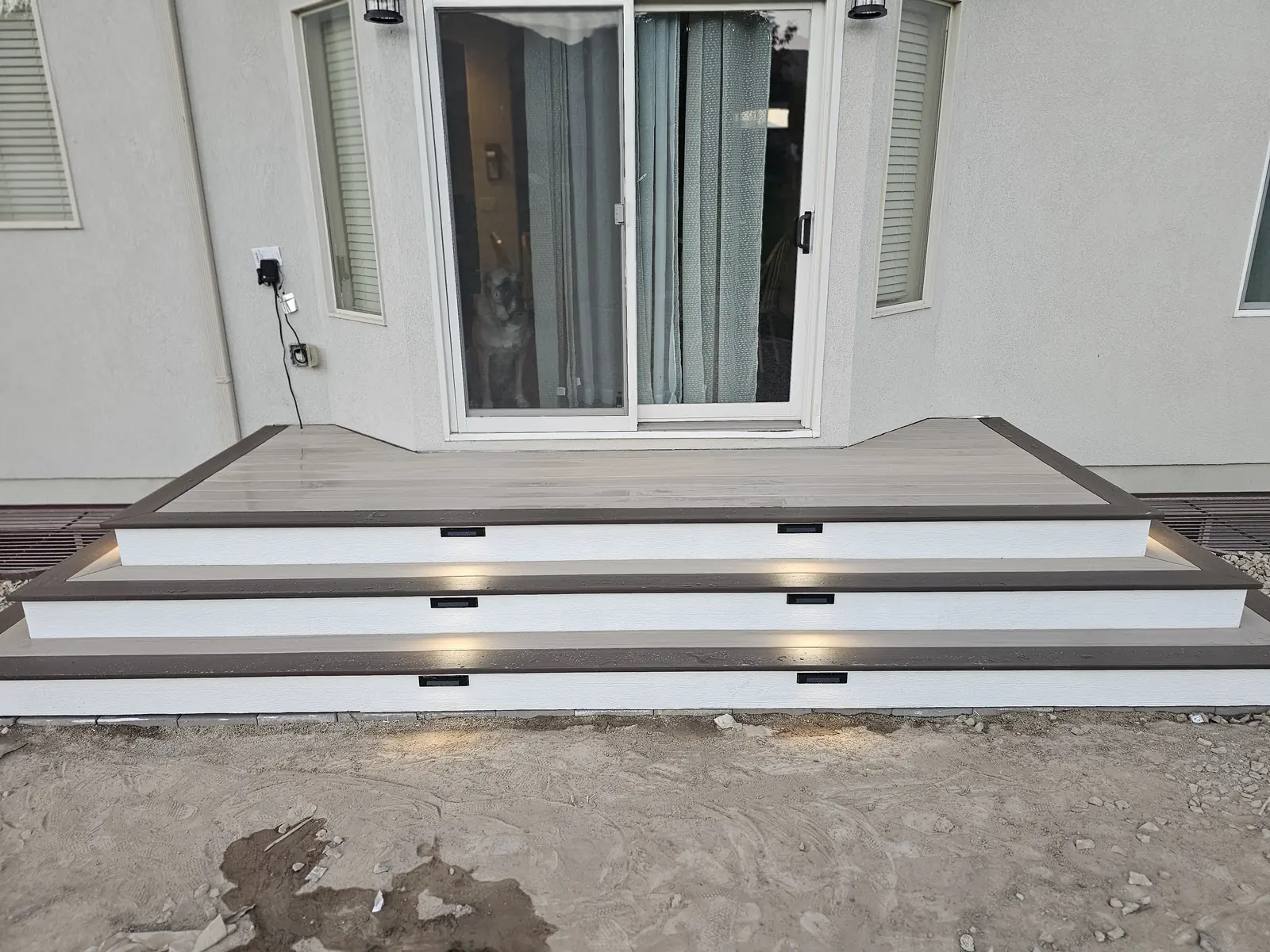
On a low deck in Saratoga Springs, we laid TimberTech French White Oak with an American Walnut border and stair nosing, white risers, and a recessed light in every riser. The steps glow at night and the dark nosing outlines each one.
Color pairings that work on Utah homes
Utah homes are mostly stucco, stone, brick and fiber-cement siding, often in grays, tans and whites. A few pairings we keep coming back to:
- Light field, dark border. French White Oak or Coconut Husk with an American Walnut or Dark Cocoa frame. Bright, modern, and a lighter field stays cooler in the sun.
- Gray field, warm border. Slate Gray with Brownstone, like the Draper deck. Great with gray stucco and stone.
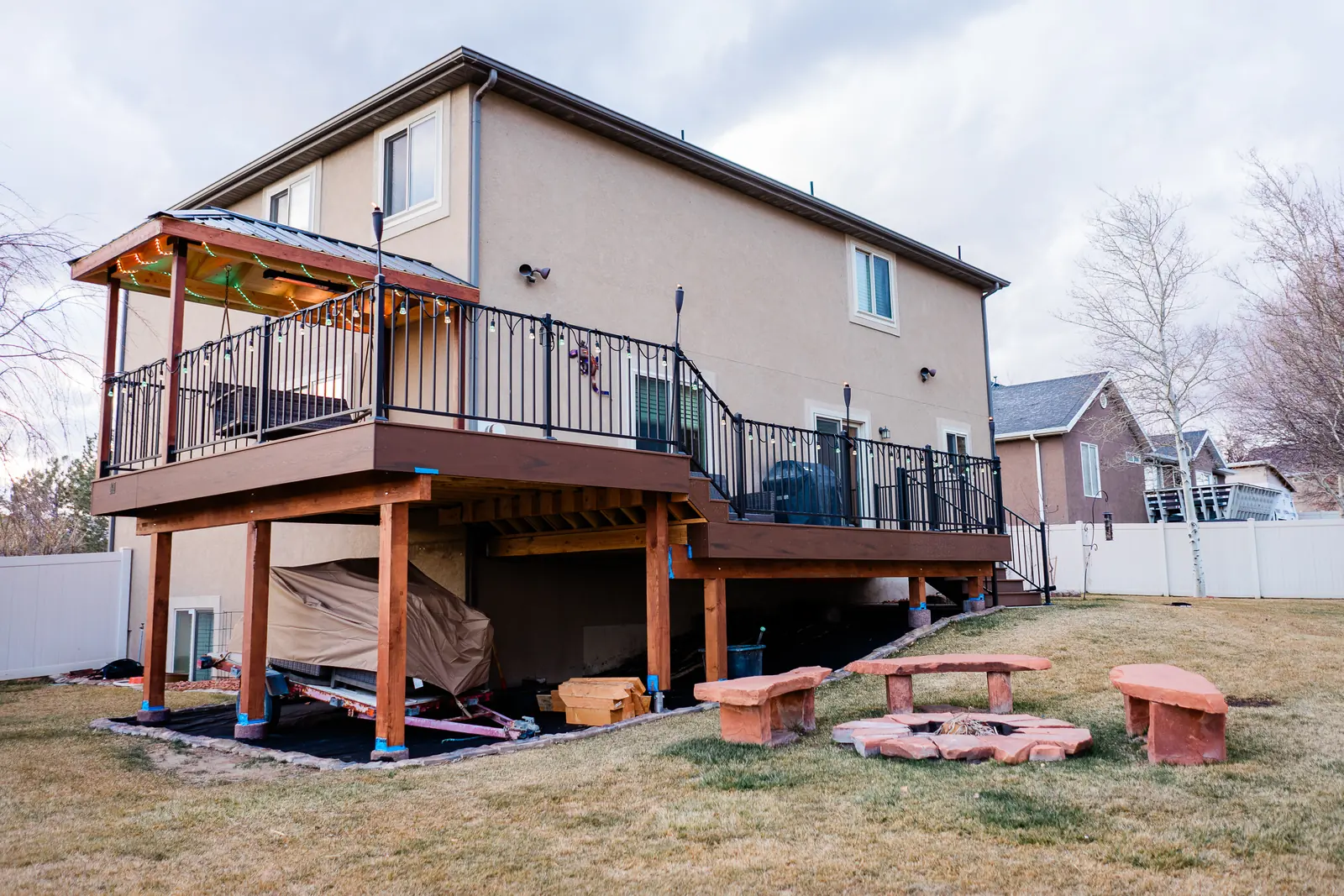
- Warm field, darker warm border. Coconut Husk with Dark Cocoa, like the two-level deck we built in Saratoga Springs with a covered swing corner and Fortress railing.
- One color, framed. A single rich color like TimberTech Legacy Pecan with a matching picture frame. Clean and classic when the home already has a lot going on.
The safest rule is to pull the border color from something already on the house: the window trim, the front door, the roof or the stone. That way the deck looks like it was always part of the home.
Other ways to add contrast
- Inlays and patterns. Diagonal fields, herringbone or a medallion. These need closer joist spacing, so we plan for them in the framing from the start.
- Mixed-width boards. Alternating board widths reads like interior flooring.
- Fascia. The boards that wrap the outside of the frame can match the border or the railing.
- Railing color. Black railing (we use Fortress in Black Sand a lot) is a contrast all on its own and works with almost any deck color.
You can browse more of these in our deck design details ideas page.
Does two-tone cost more?
There’s a little more labor in cutting and fitting a border and breakers, so it’s not free. But compared with the deck as a whole, it’s one of the best-value upgrades there is. We’ll walk you through the options on your free phone estimate. If you’re still picking a board, see our TimberTech deck page for the lines we install, or try the deck planner to sketch out your ideas.
Plan your two-tone deck
Bring us a photo of your house and we’ll suggest a pairing that fits it. Once your job is booked, our 3D renderings let you see the colors on your home before we build. Call TC Decks at 801-472-8939 or request a free estimate. Every deck is backed by our 7-year workmanship warranty.