
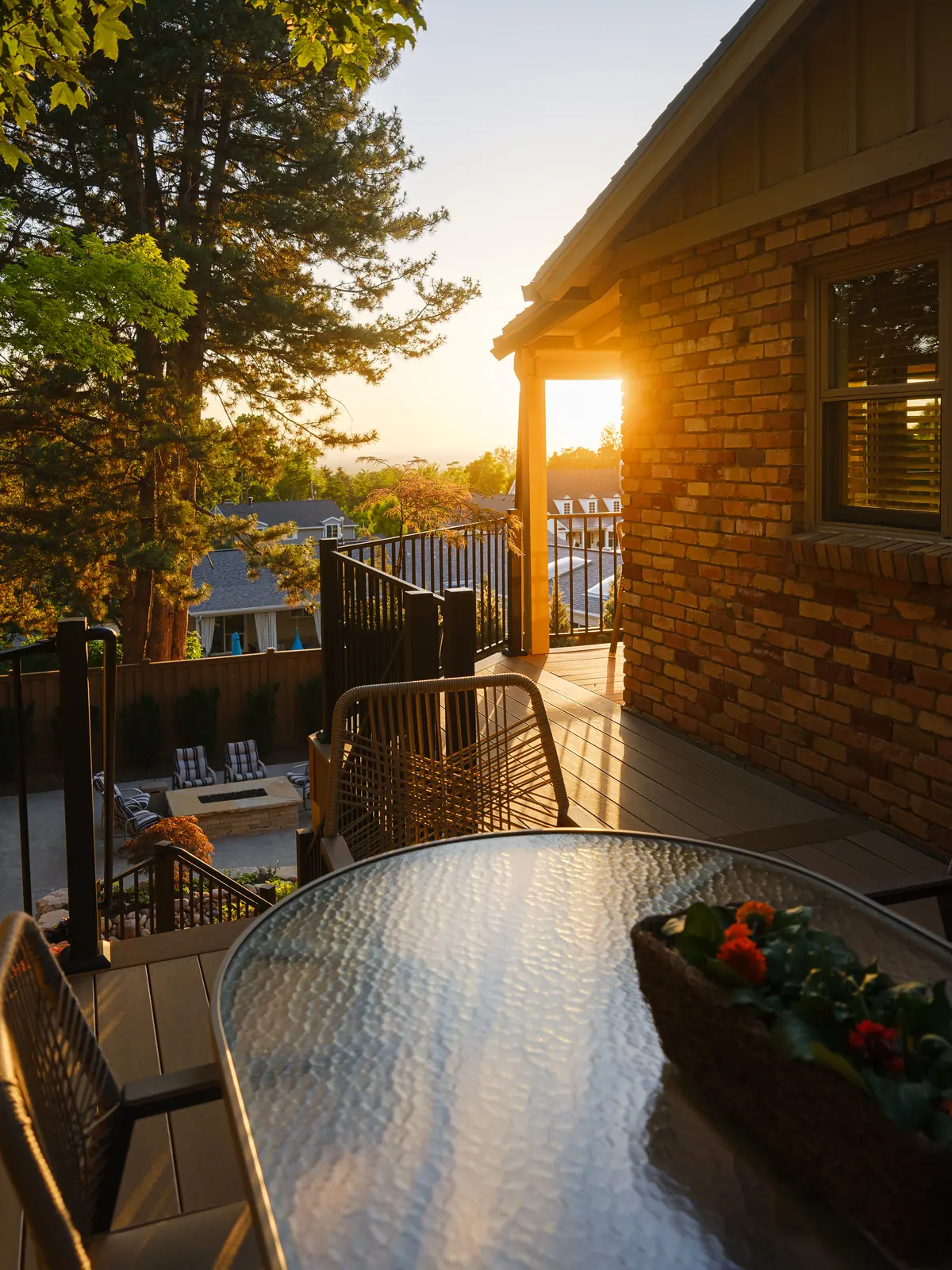
Short answer: low-end composite is a good deck board, but higher-end PVC looks better, holds its color longer, stays cooler underfoot, and stands up to Utah sun far better. Whether that’s worth the extra money depends on how long you’ll live there and how much the look matters to you.
I’ve been building decks for over 20 years, and for the last 6 years decks are all we do at TC Decks. That’s roughly 500 decks across Utah County, mostly with TimberTech, plus some Deckorators and Eva-Last. Here’s what I tell homeowners when they ask me this exact question.
How I quote it: three tiers, side by side
Every proposal I hand over starts with a low-end board, then shows what it takes to upgrade.
| Tier | TimberTech lines | Who it fits |
|---|---|---|
| Value | Prime, Premier, Terrain (composite) | Tight budgets, rentals, shorter stays |
| Premier | Harvest, Landmark, Reserve | Better look without the top price |
| Luxury | Vintage, Legacy (Advanced PVC) | Long-term homes where looks matter most |
I bid the value option first on purpose. If I only quoted the top lines, I’d lose a lot of jobs to cheaper bids. Showing all three lets you see exactly what the upgrade buys you.
What actually changes once the deck is built
After a few Utah summers and winters, the gap between low-end composite and Advanced PVC is easy to see. These are the differences I notice most:
- Looks. Advanced PVC has realistic color variation and deeper wood-grain embossing. Low-end boards tend to look flat and dated next to it.
- Capping. The protective cap on low-end boards can peel. The core material underneath is lower quality, too.
- Scalloped profiles. Many entry-level boards are scalloped (hollowed out underneath). They look cheaper from the edges and, in my experience, scratch more easily.
- Fading. Our high-altitude sun is brutal. I’ve seen scalloped composite boards fade noticeably within 2 to 3 years.
- Heat. Lighter-colored PVC stays much cooler than composite. If you have kids or pets running barefoot in July, this one matters.
For a brand-by-brand look, see how TimberTech, Trex and Deckorators compare.
Two real jobs that show the difference
Case study 1: The hot tub scratches
I’m on Bullfrog Spas’ trusted partner list, so I see a lot of hot tub installs. When deck boards get scratched while a tub is being moved into place, it’s almost always a low-end scalloped board.
Fixing that means new boards, new fasteners and the labor to swap each one out. A few scratched boards and you’ve eaten a good chunk of what you saved by going cheap. If a hot tub is in your plans, read our guide to hot tub, cold plunge and sauna decks.
Case study 2: The Sea Salt Gray extension
A homeowner wanted to add onto their existing deck without replacing the old boards. We matched the same Sea Salt Gray composite. But after just 2 to 3 years in the sun, the original boards had faded so much that the new ones didn’t look like the same product.
I showed them the mismatch before we installed. They were trying to save money, so they decided to live with it. That was a fair call for them, but it’s a good reminder: fading on low-end boards is real, and it shows up fast here.
When low-end composite is the right call
I tell people all the time: low-end composite isn’t a bad board. It’s a big step up from natural wood, with far less maintenance (more on that in wood vs. composite in Utah’s weather). I’d recommend it without hesitation for:
- Rental properties
- A home you plan to sell in the next few years
- Low-visibility areas, like a side yard or back landing
- Any project where the budget is firm
If any of those describe you, save the money. You’ll still get a solid deck.
What homeowners actually choose, and why
When customers see all three tiers, about half pick the value option. The rest split roughly evenly: about 25% go mid-tier and 25% go luxury.
The people who upgrade usually do it for the looks, followed by quality and longevity. Vintage Weathered Teak was one of our best sellers this year. It pairs well with brick, stucco, and siding, which covers most homes around here. You can see it on our Sandy covered deck.
Does the warranty matter?
Less than you’d think. The low-end lines carry roughly a 30-year manufacturer warranty, and Advanced PVC carries about 50 years. Many of my luxury-tier customers are older, and they joke, “We won’t be here for 50 more years anyway.”
My honest opinion: those numbers are more marketing than anything. If a board fails at year 30, most homeowners won’t file a claim. They’ll just replace the deck. Buy the board for how it looks and performs, not for the warranty.
Don’t forget the frame
Here’s what most blog posts skip: your deck boards may outlast what’s holding them up. I tell customers they’ll be lucky to get 20 years out of a standard wood frame. Putting 50-year boards on a 20-year frame doesn’t make much sense.
If you’re paying for premium boards, consider upgrading the framing too:
- OC composite framing lumber. My first recommendation. It won’t rot like wood.
- Fortress steel framing. A bigger added cost, but built for the long haul.
- Joist tape on wood frames. If you stay with wood, protect it. Every wood-frame deck we build includes G-Tape or FastenMaster Deck Protect on the joists. It adds real years to the frame.
Alternative framing is a significant upfront cost, and plenty of homeowners pass on it. But if you’re investing in Advanced PVC, it’s worth a serious look.
What I’d put on my own deck
If it were my house, I’d go all in on the long-term build:
- Framing: OC composite lumber, including the stairs, in black
- Boards: TimberTech Advanced PVC, with French White Oak as the main color and American Walnut as the accent (my favorite combo, though my wife gets the final say on color)
- Railing: Frameless glass rail
- Privacy: Hideaway privacy screens where needed
Quick checklist: which board is right for you?
- Staying in the home 10+ years? Lean toward Advanced PVC.
- Kids or pets barefoot in summer? Choose a lighter PVC color.
- Adding a hot tub? Skip scalloped boards.
- Rental, quick sale, or firm budget? Low-end composite is a smart buy.
- Going premium on boards? Upgrade or protect the frame too.
Not sure which tier fits your project? Contact TC Decks for a free estimate over the phone. We’ll show you all three options side by side so you can decide what’s worth it for your home.